Dr Olga Golyshina of Bangor University held a seminar for the Environmental Microbiology and Biotechnology module. It was a reminder of how such small organisms play such a huge part in this world.
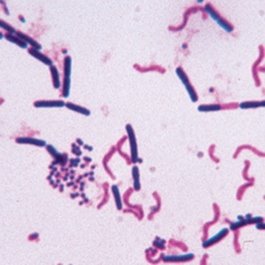
Photo source: https://www.chegg.com/homework-help/questions-and-answers/many-different-bacteria-present-sample-differentiate-describing-cell-morphology-gram-stain-q30808541
Students were provided with yet another example of how incredible bacteria are, with species living in mining sites rich in metals using oxygen to extract the metals from their ores. This releases energy which these revolutionary unicellular organisms then use. This has since been exploited by scientists, with a view to using these microorganisms to extract metals from their ores in industry. This is extraordinary. It’s fascinating that these small prokaryotes are so often the ones teaching us humans how to improve our own way of life.
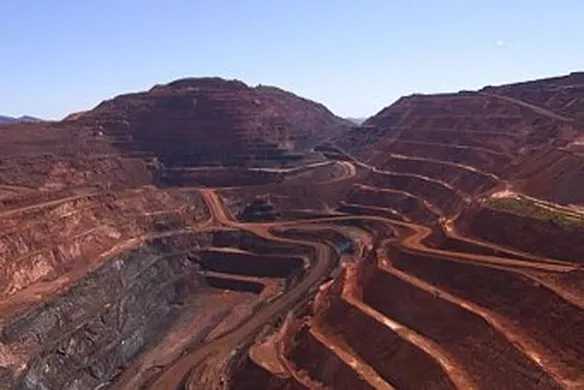
Photo source: https://www.abc.net.au/news/rural/2013-07-09/business-reporter-di-bain-investigates-the-dilemma/4808788
The point was raised that nowadays, metals are ‘taken for granted’. With Europe having many ore sites yet to be exploited, it’s tempting to ask –
What microbial secrets lie here? What innovations might they inspire?
There are plans to extract metals in active mining sites using ‘bioleaching’. However, to avoid harming the environment, scientists first had to understand the mechanisms of this process. For example, the risk of harmful metals seeping out and damaging the environment was considered before applying this method to industry.
Compared to traditional blasting using explosives, bioleaching has been found to extract the same amount of metal in 6 months that would have been obtained in 3 years. A further issue with blasting is that sulphur fumes made workers sick and resulted in one of the first environmental protests at the time.
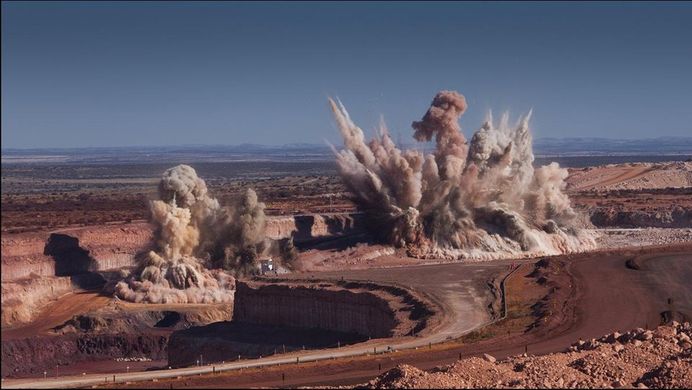
Photo source: https://www.australianmining.com.au/features/blasting-at-anglo-americans-kolomela-iron-ore-mine-images/
Molecular biology has shown that even the simplest of all living systems on the earth today, bacterial cells, are exceedingly complex objects. Although the tiniest bacterial cells are incredibly small, weighing less than 10-12 gms, each is in effect a veritable micro-miniaturized factory containing thousands of exquisitely designed pieces of intricate molecular machinery, made up altogether of one hundred thousand million atoms, far more complicated than any machine built by man and absolutely without parallel in the nonliving world. ― Michael Denton, Evolution: A Theory In Crisis
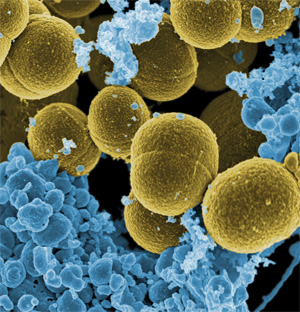
Photo source: https://io9.gizmodo.com/could-metal-excreting-bacteria-avert-the-next-world-war-5278922
Another interesting point raised was that microorganisms working together are more effective than those working in isolation. This is because different microbial species will have different enzymes meaning they can catalyse different chemical reactions.
The aim is to extract metals using microorganisms without harming the environment.
It was interesting to learn that bioleaching ‘occurs at different rates for different metals’ – something I may not have considered but definitely makes sense given the difference in size and atomic structure, among other factors.
The sheer range of uses metals have makes this talk even more exciting. You really never know what you’re going to find out. This opened my eyes even further to the importance of microorganisms, I’m going to need to blink eventually.

 Joe's blog