Having been a sport enthusiast for most of my life, this talk captured my interest.
Dr Alun Hughes from Liverpool John Moores University had travelled to Bangor to present his research progress in chronobiology and how regular exercise in his transgenic mice can stabilise unusual circadian behaviour.
Hughes introduced the concept of circadian rhythms – changes in an organism following a daily cycle that can be either physical, mental or behavioural e.g. sleeping at night and waking up in the morning.
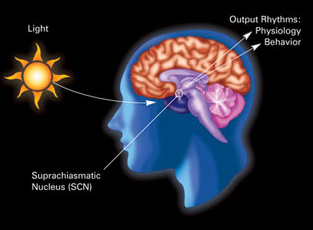
Photo source:
https://www.nigms.nih.gov/education/pages/Factsheet_CircadianRhythms.aspx
These circadian rhythms are produced and controlled by biological clocks – systems composed of proteins that interact with specific cells in the body to initiate a specific daily response.
Dr Hughes expressed his particular interest in the effect of exercise and diet on these biological clocks.

Photo source:
https://fitness.mercola.com/sites/fitness/archive/2013/09/13/eating-before-exercise.aspx
Having captured my interest, I read Hughes’s most recently published paper after this seminar titled ‘Locomotor exercise and circadian rhythms in mammals’:
http://researchonline.ljmu.ac.uk/9098/
Discussing this research, Dr Hughes suggested that locomotor exercise can alter the circadian phase ‘acutely’.
With success in this area of work using transgenic mice as the model organism, knowledge of such effects on human health has improved.
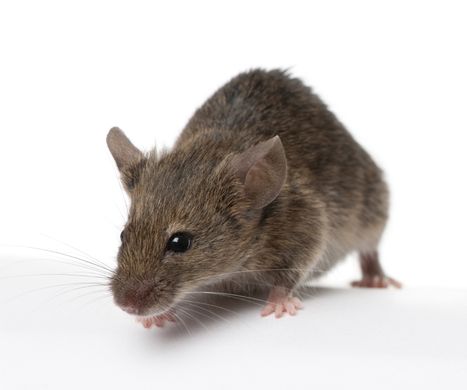
Photo source:
https://tomlinsonbomberger.com/blog/tis-the-season-for-mice-in-your-attic/
While the topic area was new and exciting to me, the importance of regular exercise, be it sprint or stroll, should be a surprise to no one.
When maintained properly, the human body is powerful and as a species we are capable of success in numerous areas. But it seems difficult to escape the feeling that someone who does not make the effort to exercise even once or twice a week is only tempting future discomfort.
That being said, you don’t need to reach the Olympic finals to have a biological clock.
Dr Hughes’s talk served as yet another reminder of 2 things:
- The broadness of biology as a subject area
- It’s time to lace up those trainers

 Joe's blog